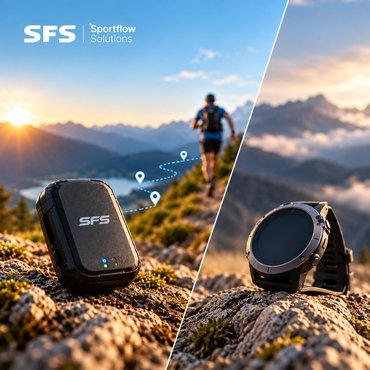
Modern sports watches can do a lot. They record GPS tracks, measure heart rate, connect to external sensors, provide navigation, and some models can even connect directly to cellular networks.
So there is an obvious question: why does Sportflow Solutions use a dedicated GPS tracker when many athletes already train with a sports watch?
The answer is not that sports watches are bad. It is about the specific problem we want to solve.
We need more than a GPS track
For many sports watches, the typical workflow is simple: the athlete records a workout and, once the session is finished, the data is synchronized with an app or cloud platform.
For Sportflow Solutions, that is not enough.
Our system is designed to work with data during the training session. A coach should be able to see the athlete’s location and receive relevant training data in near real time.
To achieve this, the device needs to perform several demanding tasks at the same time:
- continuously use GNSS positioning;
- maintain a cellular connection;
- transmit data to the server;
- communicate with additional sports sensors;
- provide enough battery life for long training sessions.
Each of these functions consumes energy. When they operate simultaneously, battery capacity and radio performance become especially important.
Why a dedicated GPS tracker?
The main limitation of a sports watch is its physical size.
A watch needs to remain small, light and comfortable on the wrist. This naturally limits the size of the battery, antennas and the available space for electronic components.
A dedicated GPS tracker gives us more freedom.
We can use a larger battery and design the device around a specific purpose: continuous positioning and reliable real-time data transmission.
The tracker does not need a large touchscreen or many of the functions found in a typical smartwatch. Instead, available power can be focused on what matters most for Sportflow Solutions: GPS, cellular connectivity, external sensors and data transmission.
GPS quality matters
For our system, a point on a map is not enough.
We want a high-quality track that can be used to understand an athlete’s movement, analyse training and, in the future, provide useful data for Sportflow Solutions algorithms.
A dedicated device gives us more freedom to optimise the positioning of the GNSS antenna and the overall radio design.
This becomes especially important in challenging environments such as forests, mountains, urban areas or situations where the athlete is moving quickly.
Modern sports watches can already provide very good GPS performance. However, a specialised tracker allows us to design the device primarily around positioning and connectivity instead of fitting dozens of different functions into a watch-sized enclosure.
The tracker as a data hub
Sportflow Solutions is also designed to work with additional sports sensors.
For example, the device can receive data from a heart-rate sensor or other compatible sensors, combine this information with GPS data and transmit it directly to the Sportflow Solutions platform.
This means the GPS tracker is more than a location device.
It becomes a communication hub connecting the athlete, external sensors, the cellular network and the Sportflow Solutions platform.
The coach does not have to wait until the workout is over before seeing what is happening.
Does this mean we are against sports watches?
Not at all.
We see sports watches as a very promising form factor.
If future watch technology can provide the battery life, reliable cellular connection, GPS quality and sensor connectivity that our system requires at the same time, a separate GPS tracker may no longer be necessary.
When that happens, we will be ready to move to watches.
For athletes, that would actually be more convenient: one device instead of several.
The device is not the goal — the data is
Sportflow Solutions is not developing a GPS tracker simply for the sake of building another device.
Our goal is to create a system that collects high-quality sports data and delivers it when it is actually useful.
Today, a dedicated GPS tracker gives us the balance we need between battery life, positioning quality, cellular connectivity and support for additional sensors.
Tomorrow, the best solution may be a sports watch.
What matters to us will remain the same: the athlete stays connected, and the coach receives high-quality data during the training session — not only after it is finished.

No comments yet. Be the first!