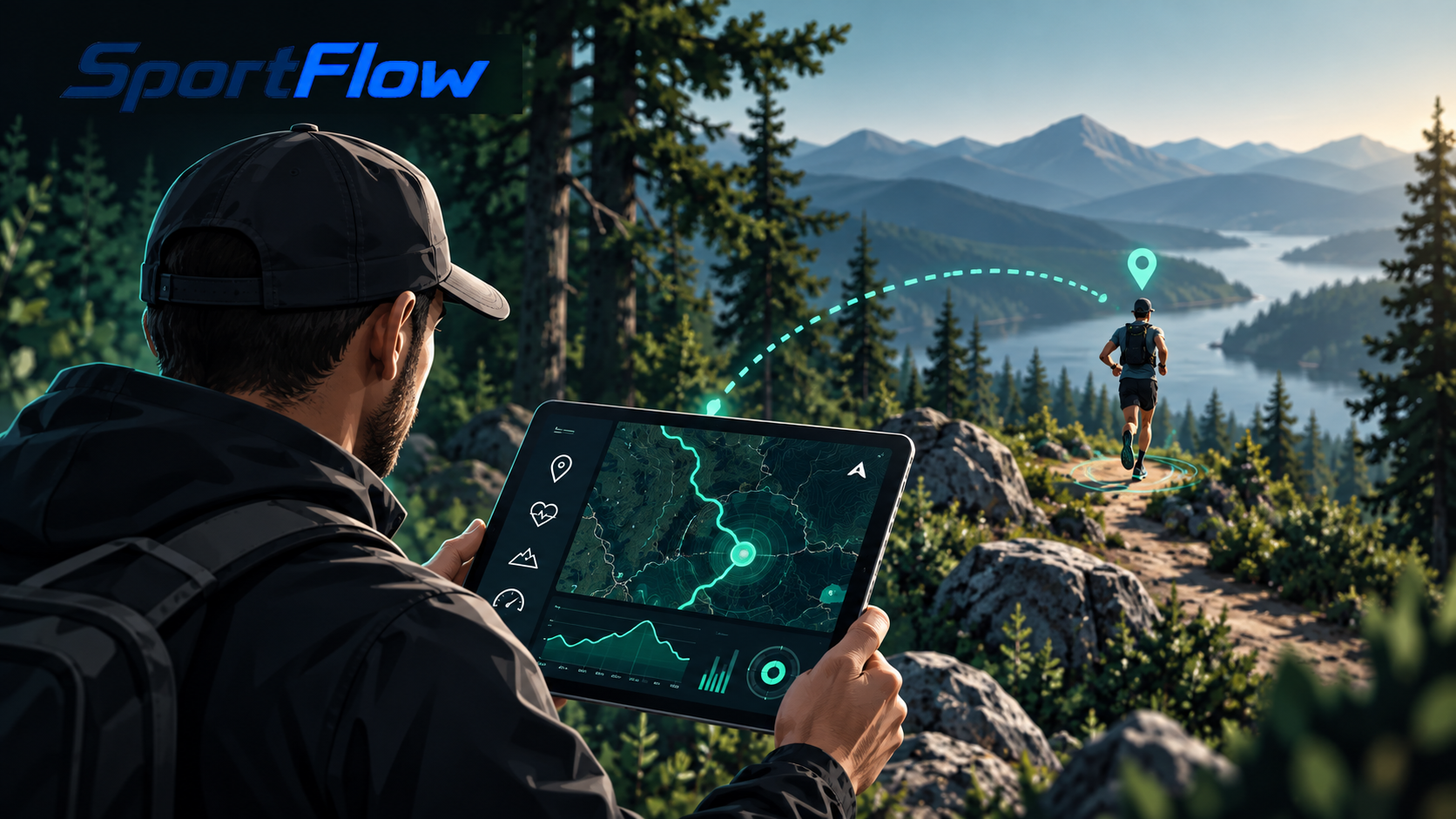
In outdoor sports, an athlete can disappear from the coach’s field of view within minutes.
A runner enters the forest. A cyclist quickly moves several kilometres ahead. An orienteer disappears between controls. A skier moves onto another part of the course.
The training continues, but much of it becomes invisible to the coach.
This is one of the problems Sport Flow Solutions is being built to address.
What happens today
In many systems, training data becomes available only after the session is finished.
The athlete returns, synchronizes a sports watch with a smartphone, the activity is uploaded to the cloud, and only then can the coach review the route, pace, heart rate and other metrics.
That works well for post-training analysis.
But there is a major difference between:
“What happened?”
and
“What is happening right now?”
When data is available during the session, it can help the coach understand the situation before the training is over.
What Sport Flow changes
Sport Flow Solutions is being designed around a shorter data path:
Athlete → Tracker → Server → Coach
The tracker receives GPS position and data from connected sensors and sends it directly to the server.
Depending on the configuration, the coach may be able to see:
- athlete location;
- movement history;
- speed and pace;
- heart rate;
- control-point data;
- emergency signals.
The important part is not only how much data is collected.
It is when that data becomes available.
More than a dot on a map
Consider an orienteering session.
An athlete is expected to move between controls, but suddenly remains in one area for several minutes or moves far away from the expected route.
That does not automatically mean something is wrong.
The athlete may have made a navigation error or chosen a different route.
But the coach already has additional context.
The same applies to other outdoor sports.
If a cyclist unexpectedly stops during a long ride, GPS provides the last known location. If an emergency signal is sent at the same time, the coach can understand the situation much faster and decide what to do next.
Technology does not replace the coach
GPS can be inaccurate. Heart rate can change for many reasons. A stop does not automatically mean there is a problem.
Sport Flow should therefore not make decisions instead of the coach.
Its role is to provide more useful information at the moment when that information can matter.
From analysing the past to understanding the present
Modern sports devices collect huge amounts of data.
But the amount of data is not the only thing that matters.
Timing matters too.
Data available after training helps analyse the past.
Data available during training can help the coach better understand the present.
That is why Sport Flow Solutions is being developed as a real-time system.
Even when the athlete is out of sight, the training should not become invisible.

No comments yet. Be the first!